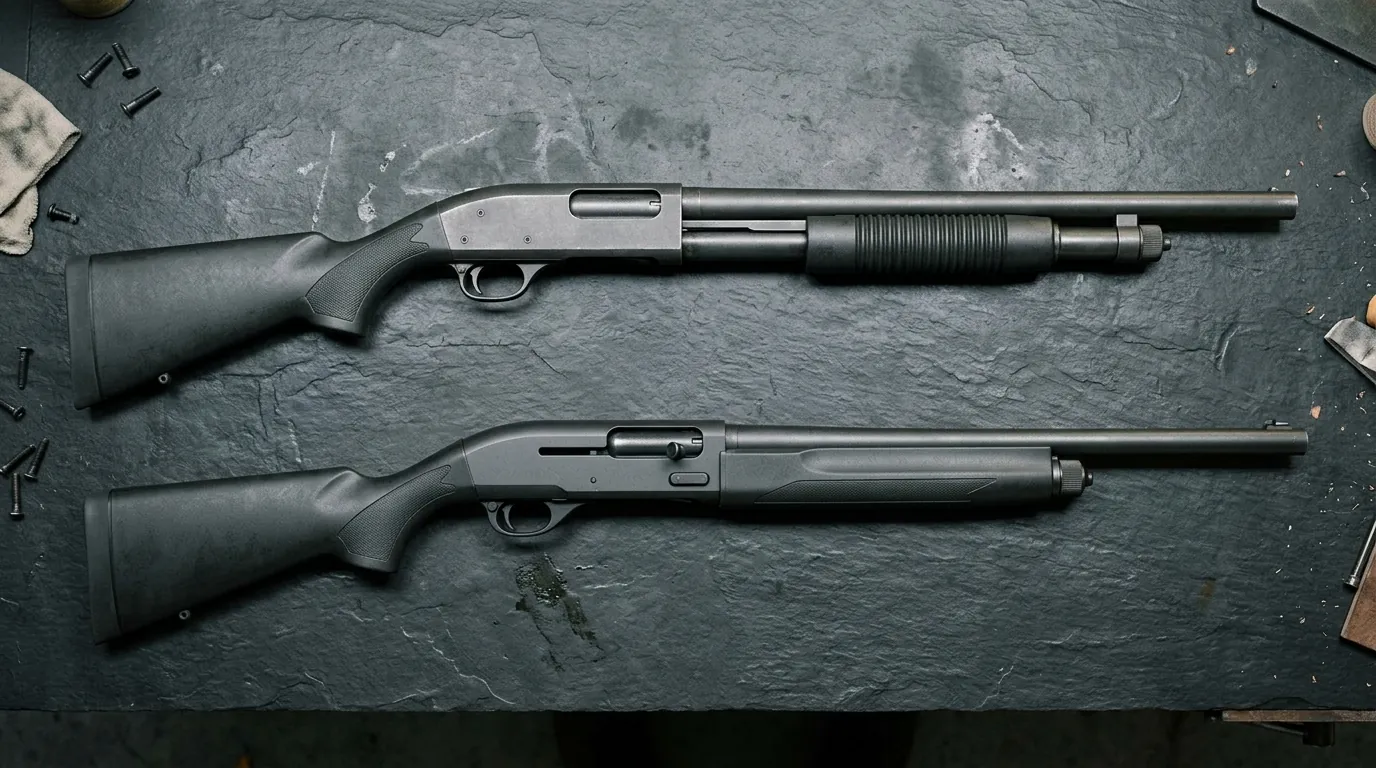
Both work. The right one depends on your budget, how much you'll practice, and the ammo you'll feed it.
Side by side
| Pump-action | Semi-auto | |
|---|---|---|
| List price on this site | $290 – $910 | $749 – $2,299 |
| How it cycles | You work the pump for every shot | The gun cycles itself after each shot |
| Ammo | Cycles almost any load, as long as you work it fully | Some light loads may not cycle reliably[1] |
| Main failure | Short-stroking under stress[2] | Ammo too light for the action[3] |
| Best for | Tight budgets, all-round use, any ammo | Fast follow-ups, competition, shooters who'll test their ammo |
Pump: simple, but you're the motor
A pump fires whatever you feed it because you cycle it by hand. The risk is the human: short-stroking happens when you don't fully cycle the action, so the gun doesn't go into battery and won't fire. It's linked to stress and to stocks that are too long.[2] Practice running the pump hard, every time.
Semi-auto: faster, but pickier about ammo
A semi-auto does the cycling for you, which makes fast follow-up shots easier. The trade-off is ammo: makers like TriStar say some light target loads don't function well in semi-autos, and recommend a minimum load.[1] Low-recoil buckshot can have the same problem in certain guns.[3] Test your defensive load before you rely on it.
Our take
If you're on a budget or want a gun that runs anything, get a pump and practice. If you can spend more and you'll test your ammo, a semi-auto is easier to run fast. Either way, add a light and fit the stock to you.
Shotguns to consider
Maverick 88 Security
Mossberg's budget Maverick line in a home-defense trim — the lowest list price of any shotgun on this list.
FROM $749 LISTStoeger M3000 Tactical
Stoeger's lower-priced tactical semi-auto — an affordable way into a semi-auto, with a smaller 4+1 tube.
Sources
Last checked October 18, 2026. Spotted something out of date? Send a correction.